If you’ve ever worked with Amazon DynamoDB, you’ve probably come across eventual consistency. At first glance, it can seem like a limitation. After all, why would a database intentionally return slightly outdated data? The answer lies in how DynamoDB is built.
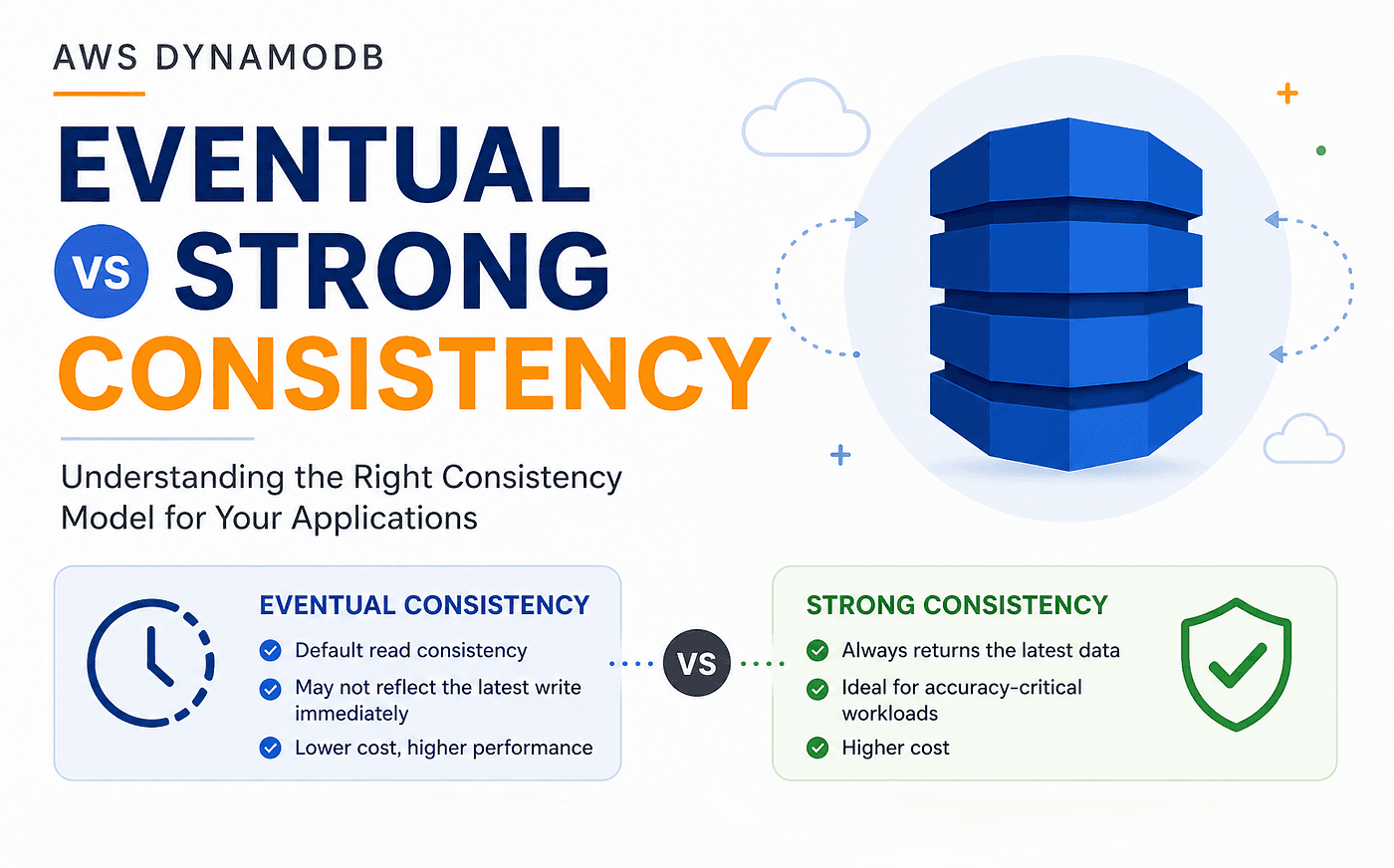
In my previous article, I explained the difference between eventually consistent reads and strongly consistent reads, along with when each should be used.
But that naturally raises another question:
Why does eventual consistency exist in the first place?
To answer that, we need to look behind the scenes at how DynamoDB stores, distributes, and replicates data. Once you understand its architecture, eventual consistency stops feeling like a compromise and starts making perfect sense.
A Quick Recap
In my previous article, we learned that, Eventually consistent reads may return slightly older data immediately after a write and Strongly consistent reads always return the latest successfully written data.
So why doesn’t DynamoDB always return the latest value? Let’s see what happens internally.
Why Doesn’t DynamoDB Store Data on Just One Server?
Imagine an online shopping platform during a massive sale. Millions of customers are browsing products, adding items to carts, placing orders, and updating payment information. If every request had to go through a single server, it would quickly become overwhelmed.
A single server would create several problems. It could become a performance bottleneck, storage would eventually run out, and also if the server failed, the application could become unavailable. To solve these problems, DynamoDB distributes data across multiple servers instead of relying on just one. This allows the database to handle enormous amounts of traffic while remaining highly available.
Partitioning
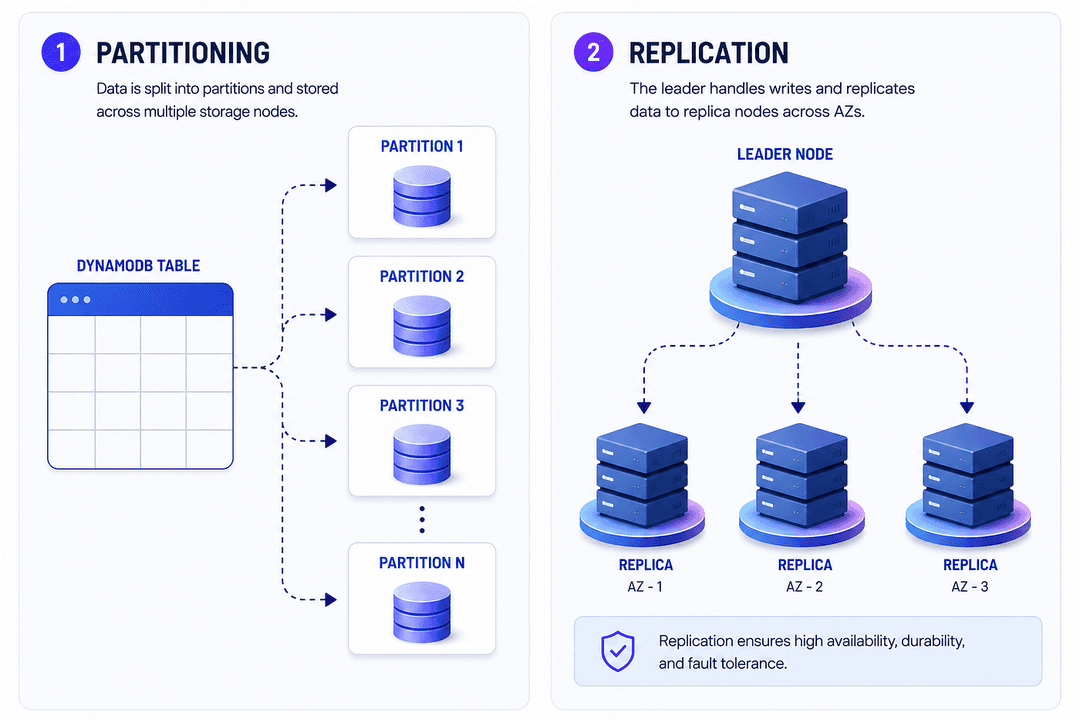
Simply, splitting the data. Instead of storing an entire table on one machine, DynamoDB divides it into partitions.
Think of a huge library; Rather than placing every book on one shelf, the library organizes books across many shelves. This makes it much easier to find and manage information.
DynamoDB works the same way. Each partition stores only a portion of the table’s data. As the amount of data or traffic grows, DynamoDB automatically creates additional partitions to spread the workload. Because different partitions can process requests simultaneously, DynamoDB can scale to support millions of requests per second.
Replication
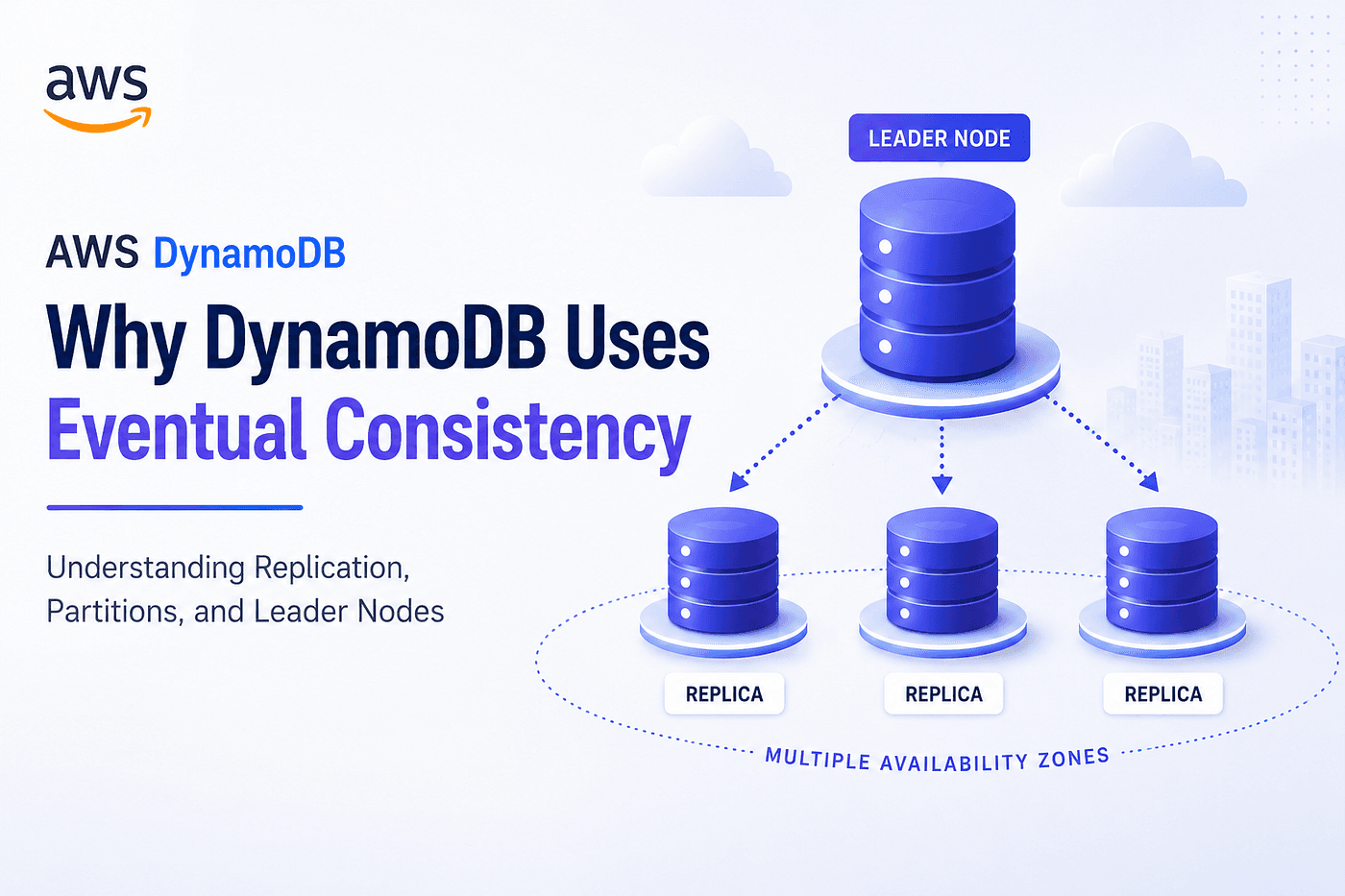
Partitioning improves scalability, but another question arises. What happens if one of those servers suddenly fails? If there were only one copy of the data, that information could become temporarily unavailable. To prevent this, DynamoDB replicates (Creating multiple copies) every partition across multiple storage nodes located in different Availability Zones.
Think about an important document; Instead of saving it only on your laptop, you also keep copies in cloud storage and on an external drive. If one copy becomes unavailable, the others are still there.
Replication provides high availability, fault tolerance and better durability. This ensures your application continues running even when infrastructure components fail.
Understanding Leader and Replica Nodes
Within each replicated partition, not every node performs the same role. One node acts as the leader, while the others act as replica nodes. The leader is responsible for accepting write operations. Replica nodes maintain copies of the same data and can serve read requests.
Although DynamoDB’s internal implementation is much more sophisticated than this simplified explanation, thinking in terms of a leader and replica nodes makes it easier to understand why eventual consistency exists.
What Happens During a Write?
Imagine a user updates their profile picture. What happens there is; first, the application sends the write request to DynamoDB, then the leader node receives the request, the leader stores the new value, the update is replicated to the replica nodes, and finally DynamoDB confirms that the write has been successfully committed. At this point, the write has succeeded.
However, not every replica receives the update at exactly the same moment. That tiny delay is the reason eventual consistency exists.
What Happens During an Eventually Consistent Read?
Now imagine the user refreshes the application immediately after updating the profile picture. The read request might be served by a replica node. If that replica hasn’t yet received the latest update from the leader, it returns the previous version of the data. A short time later, usually within milliseconds, the replicas synchronize, and future reads return the latest value. This is exactly what eventual consistency means. The system guarantees that all replicas will eventually converge to the same state.
What Happens During a Strongly Consistent Read?
With a strongly consistent read, DynamoDB ensures that your read reflects all successful writes before returning the data. Instead of reading from a replica that might still be synchronizing, DynamoDB returns the latest committed value. This guarantees accuracy but requires additional coordination, making strongly consistent reads slightly slower and more expensive than eventually consistent reads.
Why Is Eventual Consistency Faster and Cheaper?
Imagine a classroom where one student has already written the latest announcement on the whiteboard while several others are still copying it into their notebooks. If someone asks a question, it’s much faster to ask the nearest student than to wait until everyone has finished updating their notes. Eventually consistent reads work in a similar way. Because reads can be served from multiple replica nodes: Read traffic is distributed, the leader handles fewer requests, latency is reduced, the database scales more efficiently and read costs are lower. This is one of the key reasons DynamoDB performs exceptionally well for high-traffic applications.
Real-World Scenarios
Choosing between eventual consistency and strong consistency isn’t just about the database, it’s about your application’s requirements. Here are a few real-world examples:
1. AI Chatbots
Imagine you’re using an AI chatbot. When you send a message, you expect to see it appear immediately. Most applications achieve this using local application state or optimistic UI updates. If another device receives that message a fraction of a second later, most users won’t even notice.
Because of this, eventual consistency is often perfectly acceptable for synchronizing conversation history across devices while keeping latency low.
2. Social Media Platforms
You upload a new photo. Your own device shows it instantly, but your friend refreshes their feed and doesn’t see it for another second. This small delay rarely affects the user experience.
For social media feeds, eventual consistency provides excellent scalability without sacrificing usability.
3. Inventory Management
Imagine there’s only one laptop left in stock. Two customers attempt to purchase it at exactly the same time. If the inventory system reads outdated information, both customers might believe the laptop is available. This could lead to overselling.
For inventory management, strongly consistent reads are usually the better choice because accuracy is critical.
4. Banking Systems
You transfer Rs.5000 to another account. Immediately afterward, you check your balance. If the balance still showed the previous amount, even for a few seconds, it could confuse users and create serious trust issues.
Financial applications typically require strongly consistent reads because every transaction must reflect the latest committed state.
5. Analytics Dashboards
A dashboard displaying website traffic updates every few seconds. If it temporarily shows 9,995 visitors instead of 10,000, that small difference is usually acceptable.
For dashboards, reports, and monitoring systems, eventual consistency offers better performance while still providing useful insights.
The Bigger Picture
Eventual consistency isn’t a weakness in DynamoDB. It’s a deliberate architectural decision that allows the service to remain fast, scalable, and highly available while handling enormous amounts of traffic.
Rather than forcing every read to wait for every replica to synchronize, DynamoDB gives developers the flexibility to choose the consistency model that best fits their application’s needs.
That’s one of the reasons DynamoDB powers applications serving millions of users worldwide.
Final Thoughts
When you first hear that a database might return slightly outdated data, it can sound concerning. But once you understand partitioning, replication, and the relationship between leader and replica nodes, eventual consistency becomes much easier to appreciate. It’s not about sacrificing correctness. It’s about finding the right balance between consistency, performance, scalability, availability, and cost.
The next time you notice a tiny delay before an update appears, remember it isn’t a bug. It’s distributed systems working exactly as they were designed to.