Building production-ready GenAI applications requires grounding your Large Language Models (LLMs) in real-time information. While static knowledge bases handle internal documentation well, applications often need to query the live web to fetch up-to-date data like regional product availability, breaking technical updates, or local compliance laws.
To solve this, developers rely on Web Retrieval-Augmented Generation (Web RAG).
However, untamed Web RAG introduces massive architectural vulnerabilities. If you let an LLM loose on the open internet, it will eventually pull data from low-quality forums, outdated blogs, or incorrect geographical regions, leading directly to hallucinations and confidently incorrect answers.
AWS just introduced a native fix for this engineering bottleneck.
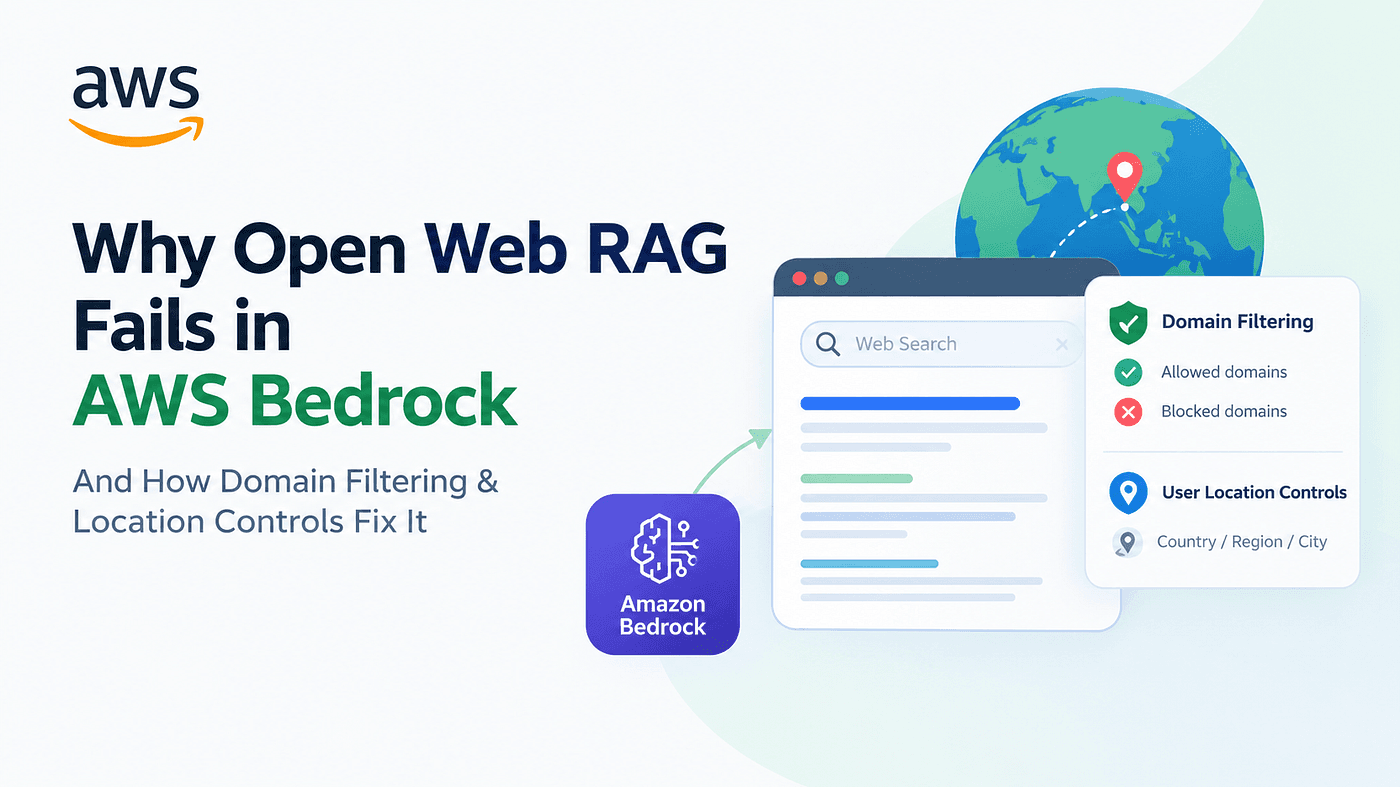
Directly configured inside the web search tool payload, AWS Bedrock now supports Domain Filtering and User Location Controls. Here is a breakdown of why open-web RAG breaks at scale, and how to implement these new native boundaries to keep your enterprise AI agents accurate.
The Main Problem: The Chaos of Unfiltered Web RAG
When an AI model uses an open-web search tool to ground its answer, it typically behaves like a standard search engine without a human operator. It fetches the top structural results for a query and injects that context directly into the model prompt context window.
This introduces three critical points of failure:
- The Hallucination Vector: If a competitor’s site, a random Reddit thread, or a deprecated documentation page ranks highly for a specific query, the LLM will accept it as factual grounding text.
- Geographic Misalignment: Asking an LLM agent about “local logistics regulations” or “regional service availability” is useless if the underlying search engine defaults to a generic server region instead of the user’s actual location.
- Middleware Overhead: Up until now, preventing these issues required developers to write complex custom middleware to get search API results, parse URLs, filter out bad domains, and manually spoof headers for geolocation before passing clean text back to Bedrock.
The Solution: Native Bedrock Search Constraints
AWS has eliminated the need for custom preprocessing middleware by embedding structural search constraints directly into the Bedrock execution loop via the OpenAI Responses API.
1. Domain Filtering
You can now explicitly guide or restrict the model’s data sourcing by defining hard structural limits. The API allows you to pass up to 100 allowed domains to enforce strict whitelist restrictions (e.g., only pulling from your official documentation or trusted .gov entities). Conversely, you can specify up to 100 blocked domains to blacklist known problematic sites, outdated forums, or competitor pages.
2. User Location Controls
Instead of getting generic search results tied to the physical AWS data center hosting your infrastructure, you can now pass granular location parameters directly with the request metadata. This forces the underlying web search tool to retrieve geographically relevant snippets essential for bots handling localized pricing, local logistics, or regional product launches.
Architectural Implementation: The API Payload
These controls are configured directly within the existing web_search tool object. Below is a simulated example of how to implement both domain filtering and location parameters inside your standard Bedrock API request payload:
{
  "model": "amazon.titan-text-premier-v1",
  "messages": [
    {
      "role": "user",
      "content": "What are the latest compliance guidelines and registration requirements for commercial drone operators?"
    }
  ],
  "tools": [
    {
      "type": "web_search",
      "web_search": {
        "filters": {
          "allowed_domains": [
            "caa.lk",
            "gov.lk",
            "://amazon.com"
          ],
          "blocked_domains": [
            "unverifiedblogpost.com",
            "outdatedforum.net"
          ]
        },
        "user_location": {
          "country_code": "LK",
          "region": "Western Province",
          "city": "Colombo"
        }
      }
    }
  ]
}
Why this payload structure works:
- Zero Custom Scrapers: The whitelists and blacklists are enforced at the retrieval layer before data ever hits your application memory or the model’s context window.
- Context Preservation: By targeting the search specifically to Colombo, Sri Lanka, and whitelisting .lk domains, the model completely bypasses generic global regulations (like FAA rules in the US or CAA rules in the UK). This drastically reduces token wastage on irrelevant international text and eliminates geographic hallucinations.
Regional Availability
As of 23rd October 2026, native domain filtering and location controls are deployed across standard enterprise AWS environments, including:
- US East (N. Virginia)
- US East (Ohio)
- US West (Oregon)
- AWS GovCloud (US-West)
a massive win for highly secure public sector applications that require strict domain whitelists.
Building reliable GenAI isn’t just about picking the largest model; it’s about building deterministic guardrails around how that model consumes data. By locking down your web search boundaries directly at the tool layer, you ensure your application stays accurate, localized, and safe from internet noise.
For precise pricing metrics and architectural constraints, refer to the Web Search configuration segments inside the official AWS Bedrock User Guide.